

Scheduling and Transportation Management with Logistocat
Centrally manage and schedule shipping orders and maintain an overview of ongoing shipping operations.
With Logistocat, you can consolidate order data, customers, vehicles, drivers, and other transportation-related information into a single, centralized system. Transportation orders can be entered, accepted, processed, and made available for further planning and execution.
This creates a consistent digital foundation for your transportation management—instead of scattered information in Excel spreadsheets, paper documents, or various standalone solutions.
Manage Shipping Orders Centrally
Complete and up-to-date order data is the foundation of reliable transportation management. In Logistocat, transportation orders can be created manually, imported, or transferred from existing systems via interfaces. This ensures that all information needed for further processing is available in one central location. Recurring transportation orders can also be automatically generated at defined intervals for future dates. Changes can be made directly to the order and then incorporated into further scheduling.
Focus on Scheduling
The dispatching system serves as a central hub for the information needed to manage transportation operations. Dispatchers have a centralized overview of upcoming transportation orders and can process them and organize their execution. The necessary information regarding orders, customers, drivers, vehicles, and other resources is immediately available. Instead of compiling information from various lists, emails, or paper documents, the dispatching department works from a single, up-to-date database.
From Transport Order to Route
After order processing, scheduled orders can be grouped into routes and then planned. For more complex requirements, Logistocat provides functions for manual and automatic route planning and route optimization. Among other things, time windows, capacities, and other operational conditions can be taken into account.
Continue to Use Existing Systems
logistocat does not need to replace existing ERP, inventory management, or order management systems. Relevant master and order data can be imported from existing systems via interfaces and used for transportation processing. In this way, logistocat specifically supplements existing enterprise software with the processes required for operational transportation processing.
From the office to the driver—and back again
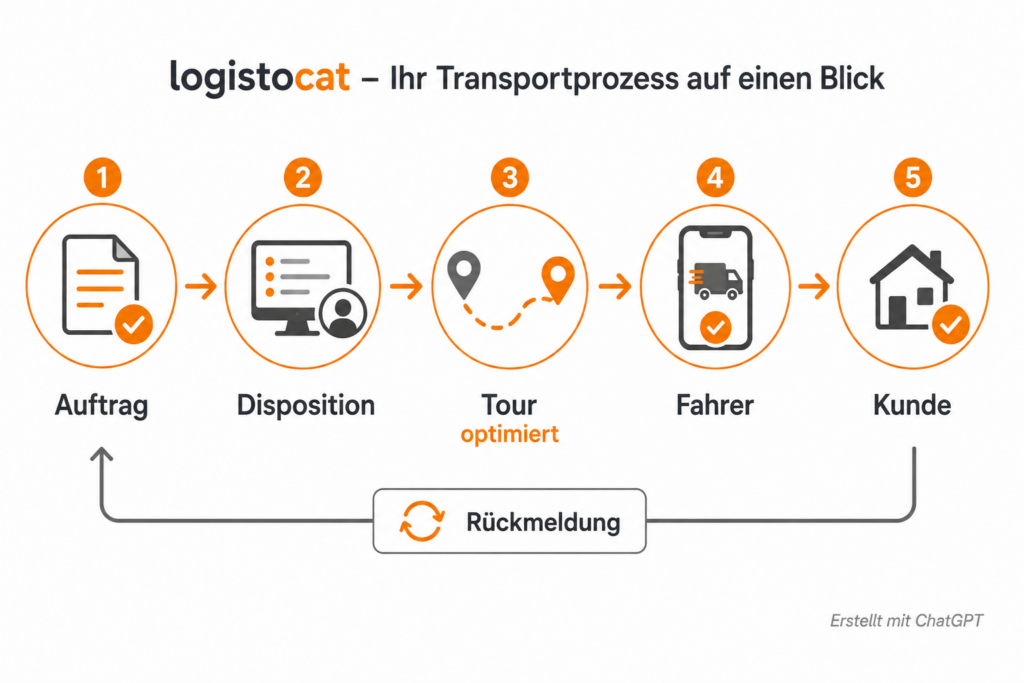
Once scheduling and route planning are complete, the necessary information can be made available to the driver digitally. Through the logistocat driver app, the driver receives their approved routes and the associated order information. Feedback from the delivery can then be uploaded back into logistocat. Mobile order processing works even in areas where a permanent internet connection is not available.
A Shared Database for Transportation Management
The key advantage lies not only in individual features, but in the integration of the individual steps.
Order → Scheduling → Further Planning → Execution → Feedback
This eliminates the need to re-enter or maintain information multiple times for each step of the process. Changes and feedback are available exactly where they are needed for further processing. In this way, logistocat helps companies map out their transportation processes digitally, step by step, in a traceable manner.
Browser-based and integrable into existing IT infrastructures
logistocat is browser-based and can be adapted to a variety of technical and organizational requirements. Depending on the specific needs, the software can be operated in a cloud environment or within a company’s own IT infrastructure. This allows companies to choose an operating model that aligns with their existing IT systems and their requirements for data management and digital independence.
Scheduling and Transportation Management as Part of Logisticocat
Scheduling and transportation management form the foundation for other processes within Logisticocat. Depending on the company’s operational needs, these may be followed by route planning and route optimization, mobile order processing via the driver app, container and asset management, as well as maintenance and service processes. These areas remain interconnected, eliminating the need to set up a separate, isolated solution for each process.
Your Freight Handling – Your Processes
Every company organizes its transportation management differently. That’s why the software should be able to adapt to existing processes—not the other way around. We’d be happy to show you how your existing transportation management can be digitized with logistocat and which of your current systems can continue to be used in the process.