
Digital Sovereignty in Transportation Logistics
Digitalization is supposed to make companies more independent. But often the opposite happens: processes adapt to the software—and companies gradually lose control over their own value creation.
When Digitalization Becomes a One-Way Street
Why Digital Sovereignty Doesn't Start in IT—But in Transportation Logistics
Reality Check:
Answer these three questions off the top of your head with "yes" or "no":
Could you replace your most critical software system within a year?
Do you know exactly which business processes currently depend on a single software provider?
Can you continue to develop your process logic independently of your software?
If there is at least one question you cannot unequivocally answer “Yes” to, it’s worth reading on.
Every business decision has one goal: greater control.
More transparency.
Greater efficiency.
Greater planning certainty.
That’s why companies invest in digitalization. They implement ERP systems, automate processes, connect locations, and create digital interfaces. The expectation is clear: better workflows and better decisions.
But with every new piece of software, something else often emerges—something that hardly anyone notices at first.
A bit of control is relinquished.
Not consciously.
Not all at once.
But gradually.
With every additional interface.
With every individual customization.
With every process decision that is no longer guided by the company’s requirements, but by the capabilities of a software solution.
The crucial question, therefore, is not:
“How digital is our company?”
But rather:
“Who actually still determines our processes?”
The most dangerous dependency does not arise in IT
When people talk about digital dependence, many think of cloud services, cybersecurity, or large international software companies.
However, the actual dependency often arises much earlier.
It arises in day-to-day business operations.
Where orders are planned, decisions are made, and customers are served every day.
Right in the midst of operational processes.
That is precisely why digital sovereignty is not merely a technical issue.
It is a business issue.
Why, of all things, has transportation logistics become a strategic business process?
Hardly any other area of a company integrates as much information as transportation logistics.
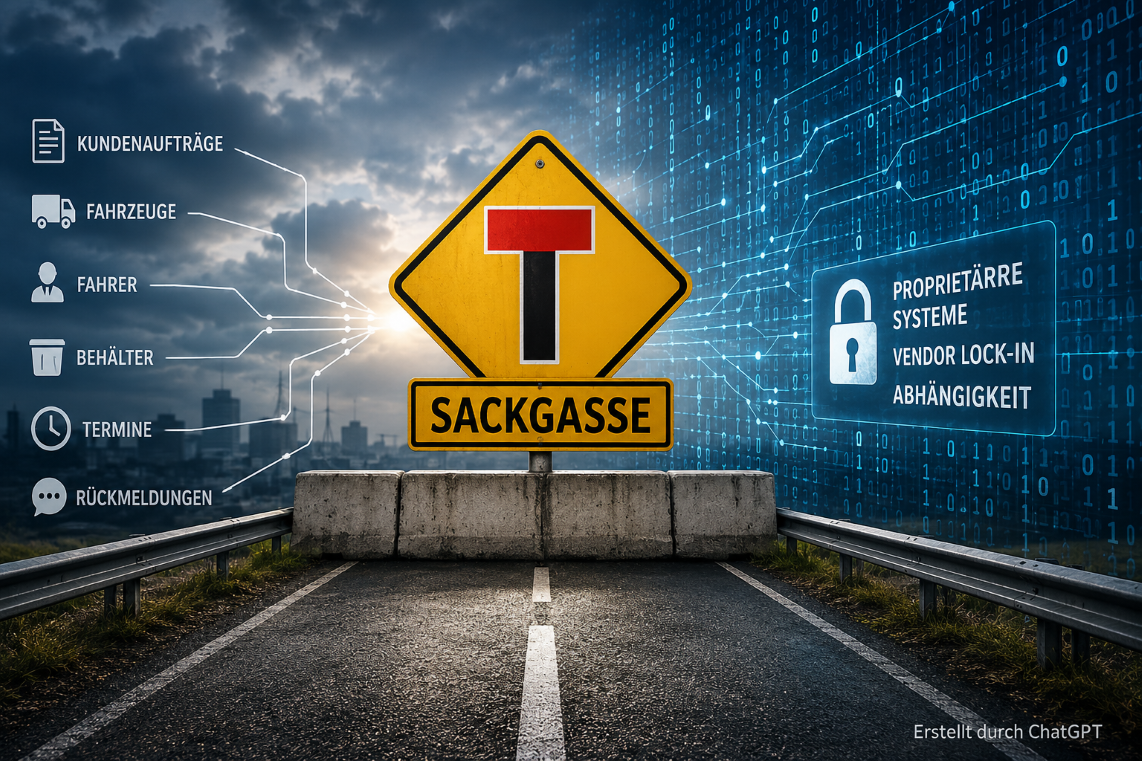
This is where a company’s “logistical nerve centers” converge:
Customer orders
Vehicles
Drivers
Containers
Resources
Schedules
Feedback
At the same time, transportation logistics connects purchasing, production, warehousing, sales, and customer service into a seamless process.
It is therefore much more than just scheduling.
It is the operational nerve center of the company.
If this process changes, the way all related departments operate will inevitably change as well.
That is why it is precisely here that it is determined whether digitalization strengthens a company’s ability to act—or quietly restricts it.
The Quiet Change
It almost always starts the same way.
A company decides to implement new software.
The project is a success.
Workflows become faster.
Information is available digitally.
Everyone involved is satisfied.
Over the years, additional requirements arise.
New interfaces are created.
Customized solutions are developed.
Special processes are set up.
New employees learn exclusively how to use the system.
No one questions the workflows anymore.
Because they work.
– Until the circumstances change.
– A new business unit is created.
– A customer demands different processes.
– The software provider changes its strategy.
– Or necessary adjustments suddenly become expensive or are no longer offered at all.
Only now does it become clear:
The data isn’t the problem.
Not even the software.
The real problem lies in the processes that have adapted to the software over the years.
Software rarely makes companies dependent.
Processes do.
Vendor lock-in begins long before switching providers
There is a well-known technical term for this situation:
vendor lock-in.
It is usually understood to mean a technical dependence on a software provider.
In practice, however, this dependency begins much earlier.
It arises as soon as companies can no longer further develop their own processes independently of a specific system.
A subsequent switch to a different provider is often merely the visible consequence of a trend that began many years earlier.
Who actually owns the process knowledge?
With every digitization, decisions are represented digitally.
Rules are stored.
Approvals are automated.
Experience is incorporated into workflows.
This raises a fundamental question:
Where is this knowledge located today?
Within the company?
Or in the minds of employees?
Or exclusively in the system?
The more companies rely on digital processes, the more important this question becomes.
After all, processes are far more than just work instructions.
They represent a company’s collective knowledge of how to serve customers, deliver services, and ensure quality.
Those who can no longer understand or influence this knowledge gradually lose the ability to actively drive their own company’s development.
Digital sovereignty means entrepreneurial freedom
Digital sovereignty is often confused with technical independence.
In fact, it describes something much more fundamental.
It means that companies understand their processes.
They control their data.
Can shape change themselves.
And decide at any time how their organization should evolve.
The focus here is not on the software.
Rather, the focus is on the company’s ability to determine its own value creation.
Five Questions Every Executive Team Should Ask Itself
If you want to know how independent your company really is, you should regularly ask yourself the following questions:
Can we fully access our data at any time?
Do we understand our process logic—or just how to use our software?
Can we influence necessary adjustments ourselves?
How dependent are we on the decisions of a single provider?
How much effort would switching actually require?
The answers to these questions often reveal more clearly than any system description just how self-reliant a company really is.
Digitalization must not make companies smaller
At MWA Solutions, we have observed for many years that companies do not fail because of a lack of digitalization. They fail because they gradually relinquish control over their ability to shape their own future.
That is precisely why, with logistocat . It’s not the company that should have to constantly adapt to the software. The software is designed to support the company’s processes.
Through co-development , we continue to develop solutions together with our customers. Open interfaces enable flexible integration. And with our Source-Accessmodel, knowledge of the digital process logic remains within the company over the long term.
For us, therefore, digitalization is not a path toward new dependencies.
Rather, it is a path to greater entrepreneurial freedom of action.
Conclusion
Today, digitalization is key to a company’s competitiveness. But competitiveness doesn’t come from modern software alone.
It arises when companies understand their processes, control their data, and can shape their own future. Transportation logistics, in particular, demonstrates just how closely operational workflows are linked to the entire value chain. Those who maintain control here not only strengthen their logistics.
They strengthen their entire company. After all, digital sovereignty doesn’t start with technology.
It begins with the freedom to continue making your own decisions about your processes tomorrow as well.
Self-Assessment: How digitally confident is your company, really?
Digital dependencies rarely arise suddenly. They develop gradually—often without anyone noticing. Therefore, check regularly to see how many of the following statements apply to your company.
Analysis
7–8 hooks
Your company already has a high level of digital proficiency.
4–6 hooks
There are some initial dependencies that should be checked.
0–3 checkmarks
It’s worth taking a critical look at your own digitalization strategy. It’s likely that external systems already drive significant parts of your processes today. Software rarely makes companies dependent. Processes do.
Watch for these warning signs:
– Processes are adapted to the software—not the other way around.
– Important decisions can now only be implemented with the support of the software provider.
– No one can explain anymore why certain processes were originally designed that way.
– Customizations make switching to a different system virtually impossible from a business perspective.
– Process knowledge is primarily stored in the system rather than within the company.
– The software’s further development increasingly dictates the company’s future direction.
The more of these statements apply to you, the more important the issue of your digital sovereignty becomes.
You can find more information on the topic of digital sovereignty here, among other places:
Bitkom on the Topic: Digital Sovereignty Infrastructure
Bitkom on Digital Sovereignty: A Position Paper
Next post in this series:
However, digital dependency isn’t caused solely by software. The knowledge possessed by individual employees can also become a critical factor of dependency for companies. In our article, we explain why this becomes a particular problem when experienced employees leave the company “What Happens When Your Long-Time Scheduler Retires Tomorrow?”