
Digital sovereignty as a competitive advantage for small and medium-sized businesses
Logistics is a top priority
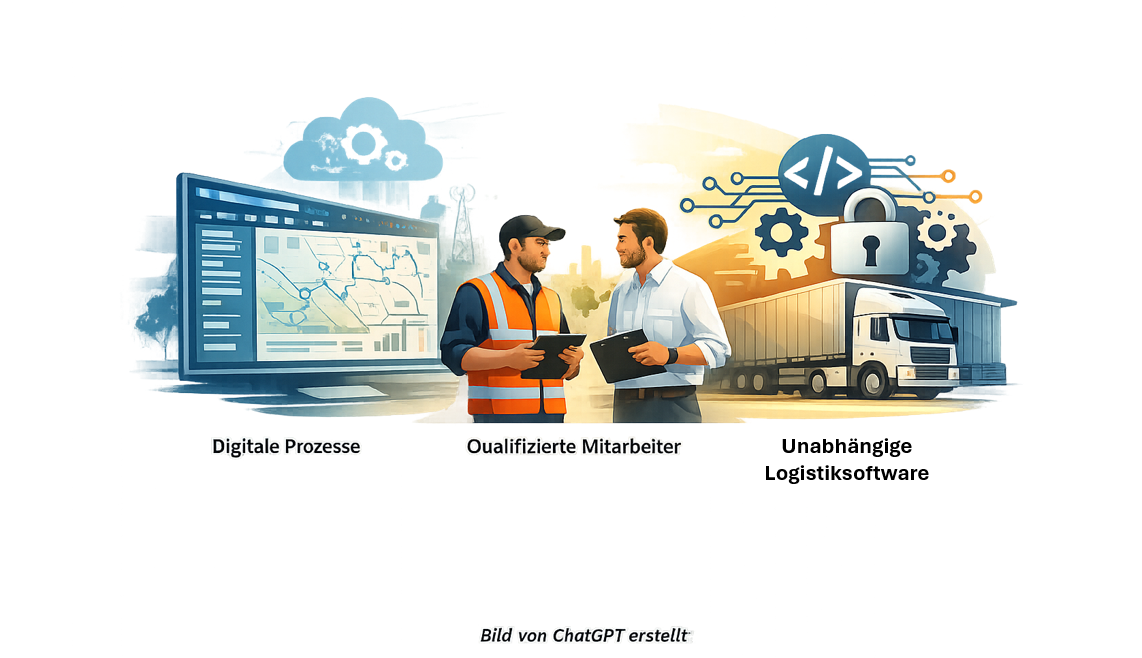
Why digital sovereignty, skilled employees, and modern logistics software are key to a company’s competitiveness today
When companies discuss competitiveness, the focus is often on sales, production, or purchasing.
Logistics, on the other hand, is often still viewed as an operational function—a necessary process that ensures goods, materials, or services arrive at the right place at the right time.
However, this view falls short today.
Because the circumstances have changed:
- rising costs
- increasing competitive pressure
- growing shortage of skilled workers
- stricter requirements for transparency and traceability
- increasingly complex customer requirements
As a result, logistics is increasingly becoming a strategic factor for success.
The key question, therefore, is no longer whether companies should digitize their logistics.
The key question is:
How can logistics be structured in such a way that it remains efficient, flexible, cost-effective, and independent in the long term?
The real challenge isn't the software
When companies consider digitalizing their logistics, they often start by looking for new software.
At first glance, that seems logical.
After all, digital tools are designed to streamline processes, promote transparency, and boost efficiency.
However, simply introducing software does not automatically solve many problems.
Why?
Because the real challenge often lies not in the absence of a system, but in the question:
How well does the implemented solution support the company's specific processes?
Small and medium-sized businesses, in particular, often have established structures, specific customer requirements, and unique ways of working.
Off-the-shelf software can only accommodate these specific requirements to a limited extent.
This often results in new dependencies, additional process steps, or time-consuming workarounds.
Who is actually shaping your company’s digital future?
When selecting logistics software for small and medium-sized businesses, many companies initially focus on features:
- Tour planning
- Order Management
- mobile applications
- Documentation
- Reports
These questions are important.
However, there is another question that is even more important:
Who will decide how this software is developed in the future?
After all, when you implement software, you’re often doing more than just purchasing a tool.
At the same time, this creates a long-term dependence on:
- Licensing models
- Manufacturer Strategies
- Release cycles
- the provider's technical specifications
Small and medium-sized businesses, in particular, often do not realize this dependence until new requirements arise and adjustments cannot be made at all, or can only be made with considerable effort.
The real strategic question, therefore, is:
Does the software shape your business—or does your business shape the software?
Digital sovereignty is becoming a competitive advantage
While digital transformation is a hot topic in many sectors, another aspect is increasingly coming into focus:
This refers to a company’s ability to independently use, adapt, and further develop digital tools over the long term.
For logistics, this means:
- Processes can change without having to switch software.
- We can accommodate individual requests.
- Expertise remains within the company.
- Strategic decisions are not influenced solely by external software providers.
One possible way to achieve this is to establish models that not only grant companies usage rights but also provide them with long-term access to the technological foundation of their systems.
Approaches such as co-development and Source Access from MWA Solutions pursue precisely this goal.
The software is not viewed as a static product, but rather as an adaptable platform that grows alongside the company's needs.
This brings about a fundamental shift in perspective:
Moving away from simply buying software.
Toward actively shaping your own digital future.
Technology alone is not enough
Amid all the discussion about digitalization in transportation logistics, one crucial point is often overlooked:
Even the best systems are of little use if people aren't on board.
Today, drivers and dispatchers in particular face significantly greater demands than they did just a few years ago. Driver training and digitalization in dispatching are therefore key elements in shaping strategic direction and proactively addressing the widely recognized shortage of skilled workers in the logistics sector.
Digital documentation, mobile apps, route optimization, real-time information, and new communication channels are becoming an increasingly common part of everyday work.
This also increases the importance of training and continuing education.
Companies that involve their employees in change processes at an early stage often reap multiple benefits:
- greater acceptance of new systems
- lower friction losses
- improved process quality
- greater employee retention
- greater security for the future
Given the demographic changes currently underway, this aspect will become even more important in the future.
Digitalization and upskilling go hand in hand
Sustainable modernization of logistics processes occurs when technology and people are considered together.
Digital tools open up new possibilities.
Qualified employees ensure that these opportunities are actually taken advantage of.
Those who invest exclusively in technology often fail to fully realize its potential.
Those who focus exclusively on professional development without modernizing their processes will also quickly reach their limits.
The most sustainable approach is to combine both methods.
After all, modern logistics isn't just about software.
It is created by people who know how to use modern tools effectively.
The future of logistics is being decided today
For many small and medium-sized businesses, the question of whether digital transformation is necessary is therefore no longer an issue.
The crucial question is rather:
How can digital transformation be structured in a way that ensures it remains economically viable, flexible, and independent in the long term—while actively involving the people within the company?
Companies that lay the groundwork for digital sovereignty today, train their employees, and consistently refine their processes are creating the conditions for sustainable competitiveness.
Conclusion
Modern logistics has long been about more than just scheduling, vehicles, and software.
It combines strategy, technology, and skilled employees into a comprehensive system.
Rather than focusing solely on new features or systems, it is increasingly worthwhile for companies to consider their digital independence.
After all, future competitiveness will not depend solely on the software that is used.
It will also depend on who controls its future development.
Companies that take a holistic view of digitalization, digital sovereignty, and employee training lay the groundwork for a logistics system that not only operates efficiently but can also be shaped independently over the long term.