Route Planning with Excel: When Business Growth Becomes a Challenge
When the company grows, but the Excel-based route planning remains the same
Why Rising Order Volumes Are Creating New Challenges for Scheduling, Route Planning, and Transportation Management
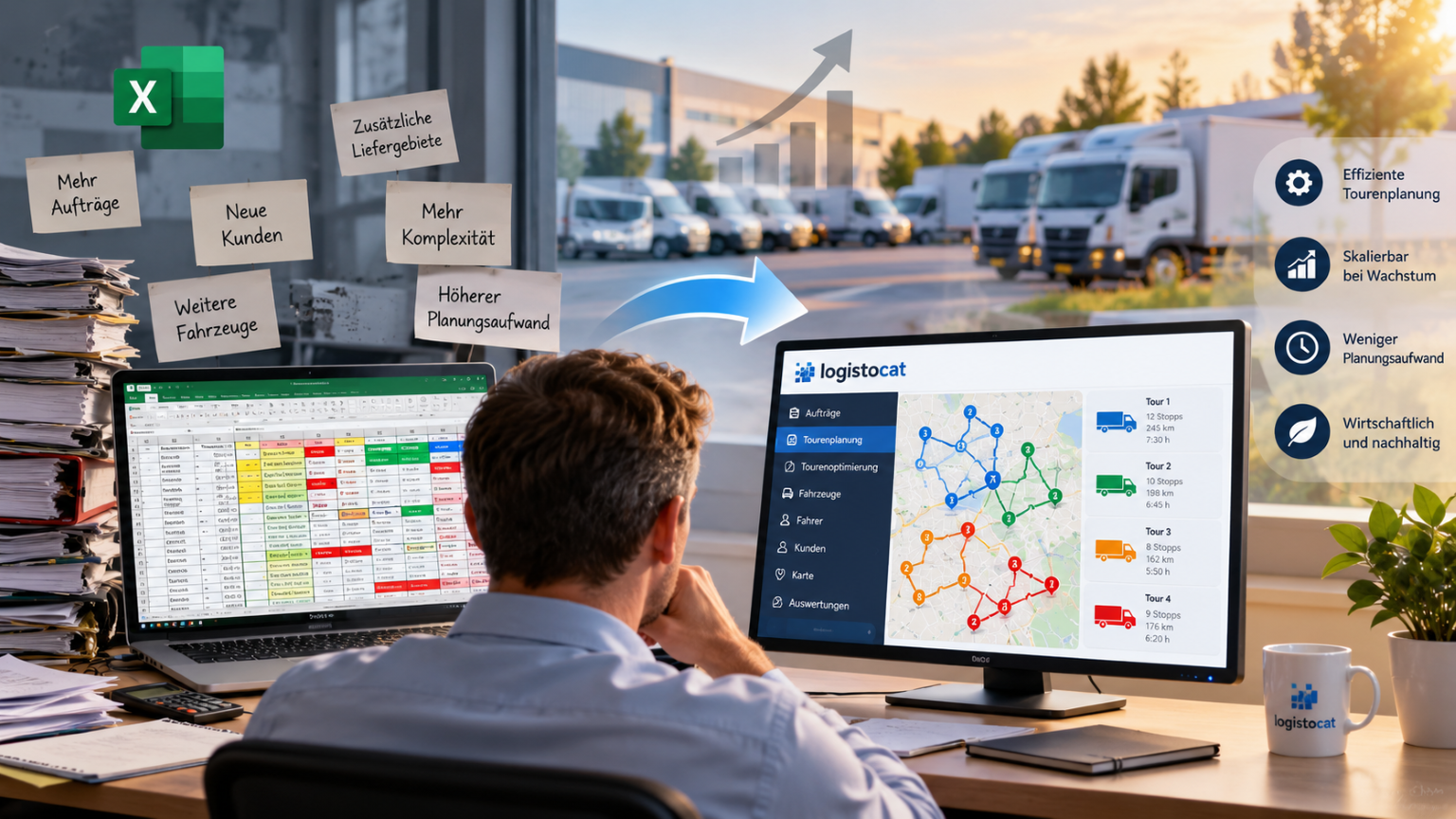
For companies, growth is initially a welcome development. New customers, rising order volumes, additional delivery areas, and a growing vehicle fleet open up new business opportunities. But as the company grows, so do the demands on its operational processes. What used to be manageable with a reasonable amount of effort is increasingly becoming a challenge. This is particularly evident in companies that deliver their goods using their own vehicles or regularly handle transport, pickup, and service orders. Route planning is often still done using Excel in these companies. This works as long as the number of orders, vehicles, and routes remains manageable. But what happens when more orders are added daily, additional vehicles are deployed, and new delivery areas need to be served? Then a simple planning task quickly turns into a complex scheduling process.
Excel isn't the problem—it's the increasing complexity
Excel offers numerous ways to collect, organize, and analyze data. For smaller companies with few vehicles and largely consistent routes, a spreadsheet-based Excel route planning system may well be sufficient. The real challenge arises when more and more information needs to be taken into account at the same time.
For example, a logistics planner must know:
- Which tasks are scheduled for which day?
- What vehicles and drivers are available?
- Which delivery addresses make sense to combine into a single route?
- What deadlines must be met?
- How do last-minute orders or changes affect routes that have already been planned?
- Which orders have been completed, and which are still in progress?
In principle, this information can also be entered into Excel. However, as the number of orders increases, keeping it up to date, linking it to other data, and incorporating it into planning requires more and more manual effort.
The key question, therefore, is not how many orders can be managed in Excel, but how efficiently and reliably new routes can be planned and executed on a daily basis using that data.
When Rising Order Volumes Become a Bottleneck in Production Planning
As a company expands, it is not necessarily just the number of transport orders that increases. The relationships between the individual planning factors also become more complex.
– An additional customer may mean new delivery addresses, different delivery intervals, or additional time constraints.
– A new delivery area changes existing route structures.
– Additional vehicles and drivers increase available capacity but also require additional coordination.
While the number of orders may increase gradually, the organizational effort can grow disproportionately.
More orders mean more manual planning work
In an Excel-based scheduling system, new orders often have to be entered manually, assigned to existing routes, or taken into account when planning new routes. With each additional order, the number of possible assignments increases. It becomes particularly challenging when multiple vehicles are available and not only the order of individual delivery addresses but also the overall distribution of orders among the vehicles must be taken into account.
Changes affect several areas of planning
A customer reschedules a delivery date. Another order needs to be squeezed in at the last minute. A vehicle breaks down. Situations like these are part of day-to-day business. With spreadsheet-based planning, the impact often has to be checked manually, and changes must be tracked through multiple steps. The more routes are planned at the same time, the greater the risk that information will be overlooked or not updated in a timely manner.
New delivery areas are making route planning more challenging
As the business expands geographically, the requirements for an efficient route structure also change. New customer locations must be integrated into existing delivery areas or grouped into new routes. It is not enough to simply consider the distances between individual addresses. The key factor is the interplay of order volume, geographic distribution, available vehicles, and the respective operational requirements. A planning approach that relies on experience-based estimates for a small number of known delivery areas cannot be arbitrarily applied to additional regions.
Reliance on the knowledge of individual employees is growing
In many companies, effective Excel-based scheduling relies on more than just the saved spreadsheets. A significant portion of the necessary knowledge resides with the employees who created these spreadsheets and work with them on a daily basis. They are familiar with the specific needs of individual customers, typical travel times, regional dynamics, and proven route combinations. This dependency becomes problematic not only as a company grows, but also when these very employees leave the company and/or retire. This is because expansion requires not only additional capacity, but also the ability to distribute tasks among other employees and to design existing processes in a way that is transparent and traceable.
Why Adding More Excel Spreadsheets Isn't a Long-Term Solution
When existing planning reaches its limits, it makes sense to use additional tables, worksheets, or more complex formulas. Macros and automated analyses can also simplify certain work steps. However, this does not automatically turn Excel into a transportation management system. Professional transportation scheduling requires more than just a structured presentation of order data. It must take into account orders, vehicles, routes, drivers, and processing status within a cohesive process. The problem, therefore, lies less in the capabilities of individual Excel functions than in the lack of a comprehensive mapping of the entire transportation process.
The more a company grows, the more important it becomes not only to simplify individual planning steps but also to integrate the entire workflow—from order entry to execution.
From Schedule Planning to Integrated Transportation Management
At this point, growing companies face a fundamental question:
Should they continue to expand their existing Excel-based planning, or is it more cost-effective to switch their transportation processes to software specifically designed for this purpose?
With logistocat, the browser-based transportation management software from MWA Solutions, order management, scheduling, route planning, and route execution can all be organized within a single software environment.
This isn’t just about replacing the existing Excel spreadsheet with a different user interface. The key difference is that the individual work steps can be linked together.
Manage orders centrally instead of entering them multiple times
Transport orders form the basis for further scheduling. In logistocat, orders can be managed centrally and made available for route planning. Existing ERP or inventory management systems can be integrated via appropriate interfaces, so that order data does not necessarily have to be re-entered manually. This can significantly reduce the organizational workload, especially as order volumes increase.
A concrete example is the integration of Lexware Office into digital route planning, through which order data can be transferred to logistocat for further scheduling.
Plan and Automatically Optimize Routes
While Excel-based planning often requires the assignment and sequencing of orders to be determined manually, Logistocat supports scheduling with features for route planning and automatic route optimization. Orders can be grouped into routes while taking the respective planning parameters into account, and their sequence can be optimized. This is particularly useful when additional customers, new delivery areas, or changes in order volumes require regular adjustments to the routes. Dispatchers retain the ability to incorporate their operational experience and individual requirements into the planning process.
Automate the preparation of recurring orders
In many companies, certain deliveries or pickups recur at set intervals. If these orders are managed exclusively in Excel, the corresponding planning data must be updated or re-entered on a regular basis.
logistocat enables the management of recurring orders and their automated creation for future time periods. This allows recurring processes to be organized more systematically and reduces manual preparation work.
Involve drivers and tour operations
Planning a route is not the end of the process. Only when the route is actually completed can you determine whether orders have been fulfilled and what information is relevant for further processing. With logistocat’s driver app, drivers can be integrated into the digital transportation process. This improves the connection between dispatch and route execution, eliminating the need to exchange all information exclusively via spreadsheets, printouts, or phone calls.
Business growth requires scalable processes
The switch from Excel to transportation management software is not merely a matter of the current number of orders. Rather, the decisive factor is whether existing processes will continue to function reliably as the business grows. A company that currently manages ten vehicles and plans to expand into additional locations or delivery areas in the coming years requires a different organizational framework than a business with just a few fixed routes. The software should not only meet today’s requirements. It must also be adaptable to changing operational structures. That is why logistocat takes a modular approach that allows different transport management functions to be combined. In addition to traditional route planning, this includes, for example, the management of containers and other assets, as well as the scheduling of maintenance and service calls. This makes it possible to map transport processes that go beyond the mere delivery of goods.
The practical implementation of logistocat at Brochwitz GmbH demonstrates how complex requirements for route planning and maintenance management can be integrated .
How the switch might affect the economy
The economic benefits of transportation management software do not stem solely from potentially shorter driving distances. The organizational implications are just as relevant. Centralized order management can reduce duplicate data entry. Automated planning steps can ease the workload on dispatchers. A seamless flow of information can reduce coordination efforts and sources of error. And a systematic organization of transportation processes can help manage rising order volumes without having to increase administrative overhead proportionally. The actual extent of these effects depends on existing workflows, order volume, and operational conditions. It is therefore crucial to assess the specific starting situation. In addition to the organizational benefits, the licensing and cost model also plays a role. MWA Solutions offers a license-free basic version of logistocat for cooperating small and medium-sized enterprises.
Growth shouldn't be hindered by route planning
For many companies, Excel is a practical starting point for structured route planning. However, as order volumes rise, additional vehicles are added, and new delivery areas are introduced, requirements change. What once worked through personal experience, manual coordination, and carefully maintained spreadsheets can increasingly become an organizational bottleneck. Integrated transportation management software like logistocat creates the conditions needed to organize order management, scheduling, route optimization, and execution within a single, unified process.
The key advantage lies not in replacing Excel with another software program, but in evolving the transportation organization so that it can grow alongside the company.
How future-proof is your current route planning?
If your order volume is increasing, new delivery areas are being added, or dispatch is becoming increasingly time-consuming, it’s worth reviewing your current processes. MWA Solutions helps companies analyze their digital transportation management needs and explore suitable ways to use logistocat.
Learn how logistocat can support your dispatch, route planning, and transportation organization.
Learn more about logistocat